If you enjoyed IBM’s “Deep Blue” chess challenge against Garry Kasparov back in 1997, you may be interested in watching its “Watson” challenge on Jeopardy! this week, Monday through Wednesday.
It’s part of IBM’s overall “Deep QA” artificial intelligence (AI) project, where the goal is to develop machines that can work with language to supplement the repertoire of human services in its global consulting practice. Such computers must be able to “understand” the questions humans ask; to mine data sources that are increasingly words-based (e.g. e-mail, digitized books, the Internet); and to narrow possibilities and arrive at helpful answers.
To that end, a computer named “Watson” (actually a stack of hundreds of computers with thousands of processors) will play the Q&A game Jeopardy against the show’s all-time top two champions -- highest money-winner Ken Jennings and undefeated Brad Rutter. Jeopardy hopes the com-pu-tition (ouch, their word) will be smart and entertaining to viewers; IBM hopes it will be smart and impressive to businesses.
Tune in to Jeopardy this week -- and learn more about the challenge on a PBS Nova program. I've been following the project a bit and, if anything, it has me ever more gobsmacked about the human brain.
Monday, February 14, 2011


Monday, January 10, 2011
2010 Top 10: You Know When the Men Are Gone
Final in the series of reviews of my 10 favorite books read in 2010, presented in alphabetical order.

You Know When the Men Are Gone
by Siobhan Fallon
They’re personal stories, not political, and they're gentle and straightforward, to be re-read more for comfort than for a layered understanding. But they’re some of the most engaging reading I’ve encountered ... in fact their readability reminds me of Kathryn Stockett’s The Help , the first book published by Penguin’s Amy Einhorn imprint which is now publishing this book.
Review based on an advance reading copy provided by the publisher

You Know When the Men Are Gone
by Siobhan Fallon
In Fort Hood housing, like all army housing, you get used to hearing through the walls. You learn your neighbors’ routines: when and if they gargle and brush their teeth; how often they go to the bathroom or shower; whether they snore or cry themselves to sleep. You learn too much. And you learn to move quietly through your own small domain.Those opening lines hooked me into this terrific collection of short stories that are linked through a shared setting of Fort Hood, Texas, its soldiers who are deployed to Iraq, and their spouses and families who stay behind. The first story sets up military domestic life and that too-closeness to neighbors and authority. The next follows a soldier serving outside Baghdad -- an investment banker who enlisted after 9/11. Others explore suspicions of adultery; wounded soldiers returning early; the difficulty of re-acclimating to home; the public honor and private grief of widowhood.
You also know when the men are gone.
They’re personal stories, not political, and they're gentle and straightforward, to be re-read more for comfort than for a layered understanding. But they’re some of the most engaging reading I’ve encountered ... in fact their readability reminds me of Kathryn Stockett’s The Help
, the first book published by Penguin’s Amy Einhorn imprint which is now publishing this book.Review based on an advance reading copy provided by the publisher
Sunday, January 9, 2011
2010 Top 10: The Visual Display of Quantitative Information
Ninth in a series of reviews of my 10 favorite books read in 2010, presented in alphabetical order.

The Visual Display of Quantitative Information by Edward R. Tufte
According to Edward Tufte, the purpose of graphics is, “Not the complication of the simple; rather [...] the revelation of the complex.” And his Visual Display of Quantitative Information, first self-published nearly 30 years ago, is now a bible -- a sort of The Elements of Style applied to information graphics.
Tufte reviews how information can be presented (e.g. a minimal amount via a sentence; a moderate amount via a table; a huge amount via a graphic) and then turns his attention to those graphics -- from their beginnings in cartography (no one who reads the book will forget Charles Minard’s graph of Napoleon’s march across Russia) to how to achieve graphic excellence today.
He urges a multi-disciplinary approach, cautioning that, “Allowing artist-illustrators to control the design and content of statistical graphics is almost like allowing typographers to control the content, style, and editing of prose.” He touches on psychology and cognition. He rails against using graphic design to deceive, and enlightens readers by pulling numerous examples of misrepresentation from prominent media. He devotes a large part of the book to improving the effectiveness of graphs by urging the elimination of “chart junk” (e.g. moiré-effect cross-hatching) and numerous other sources of “non-data ink.” In fact, a chapter wherein he strips away seemingly necessary text, frames, hatch marks, etc. (leaving little more than an ether vapor but in the process simplifying and clarifying the meaning) is revelatory.
So many books I've read recently have referenced Tufte, and I'm thrilled to have finally read him directly.

The Visual Display of Quantitative Information
by Edward R. TufteAccording to Edward Tufte, the purpose of graphics is, “Not the complication of the simple; rather [...] the revelation of the complex.” And his Visual Display of Quantitative Information, first self-published nearly 30 years ago, is now a bible -- a sort of The Elements of Style
applied to information graphics.Tufte reviews how information can be presented (e.g. a minimal amount via a sentence; a moderate amount via a table; a huge amount via a graphic) and then turns his attention to those graphics -- from their beginnings in cartography (no one who reads the book will forget Charles Minard’s graph of Napoleon’s march across Russia) to how to achieve graphic excellence today.
He urges a multi-disciplinary approach, cautioning that, “Allowing artist-illustrators to control the design and content of statistical graphics is almost like allowing typographers to control the content, style, and editing of prose.” He touches on psychology and cognition. He rails against using graphic design to deceive, and enlightens readers by pulling numerous examples of misrepresentation from prominent media. He devotes a large part of the book to improving the effectiveness of graphs by urging the elimination of “chart junk” (e.g. moiré-effect cross-hatching) and numerous other sources of “non-data ink.” In fact, a chapter wherein he strips away seemingly necessary text, frames, hatch marks, etc. (leaving little more than an ether vapor but in the process simplifying and clarifying the meaning) is revelatory.
So many books I've read recently have referenced Tufte, and I'm thrilled to have finally read him directly.
Saturday, January 8, 2011
2010 Top 10: The Last Days of Ptolemy Grey
Eighth in a series of reviews of my 10 favorite books read in 2010, presented in alphabetical order.

The Last Days of Ptolemy Grey
by Walter Mosley
Here it’s 2006 and 91-year-old Ptolemy Grey lives alone in squalor in south-central LA. He has a small pension, he has a radio and a TV tuned 24/7 to a dueling background of classical music and cable news, and he has sporadic contact with extended family two and three generations down the line. But his home and mind have declined since his wife died decades ago, and now dementia keeps him obsessed about the ages-ago deaths of a childhood friend in a house fire and the lynching of a beloved mentor. So when another loved one dies in street violence, and a new young friend awakens Ptolemy's spirit, he embarks on a mission to protect his loved ones before his own time comes.
Mosley narrates almost completely in scenes here -- from Ptolemy’s perspective, a mix of confusion and distraction co-mingled with vestiges of philosopher and keen observer. A key plot point about experimental drugs approaches magical realism and requires a suspension of disbelief ... or maybe it just required me to fully enter a world where the rules don’t resemble the ones I know, and to appreciate the point of this book: being awhile with this man in that world. I loved every page of it.
Review based on an advance reading copy provided by the publisher

The Last Days of Ptolemy Grey
by Walter Mosley
He only had one chair, and that had a book, a glass of water, and three stones he’d found that day at the park on it. They were blond stones, a color he’d never seen in rock and so he picked them up and brought them home, to be with them for a while.That’s exactly why I read Walter Mosley -- to “be awhile” with his characters, whose situations and moral complexities I always think I haven’t seen, and whose unfamiliarity always softens into a fond recognition.
Here it’s 2006 and 91-year-old Ptolemy Grey lives alone in squalor in south-central LA. He has a small pension, he has a radio and a TV tuned 24/7 to a dueling background of classical music and cable news, and he has sporadic contact with extended family two and three generations down the line. But his home and mind have declined since his wife died decades ago, and now dementia keeps him obsessed about the ages-ago deaths of a childhood friend in a house fire and the lynching of a beloved mentor. So when another loved one dies in street violence, and a new young friend awakens Ptolemy's spirit, he embarks on a mission to protect his loved ones before his own time comes.
Mosley narrates almost completely in scenes here -- from Ptolemy’s perspective, a mix of confusion and distraction co-mingled with vestiges of philosopher and keen observer. A key plot point about experimental drugs approaches magical realism and requires a suspension of disbelief ... or maybe it just required me to fully enter a world where the rules don’t resemble the ones I know, and to appreciate the point of this book: being awhile with this man in that world. I loved every page of it.
Review based on an advance reading copy provided by the publisher
Friday, January 7, 2011
2010 Top 10: The Imperfectionists
Seventh in a series of reviews of my 10 favorite books read in 2010, presented in alphabetical order.

The Imperfectionists by Tom Rachman
Rachman's debut novel is the story of an international English-language newspaper in Rome, told through alternating threads: a series of biographical vignettes tracking the newspaper from its founding in 1953 to the economy of today’s print media; and a series of linked short stories involving the newspaper’s employees (and one reader).
The stories are terrific! Set within the workplace and outside in personal life, they involve lots of characters yet each is effectively unpacked -- background characters just enough to make them memorable, main characters enough to make the reader care; many are developed further as they appear again in later stories. They’re fast stories, with lots of dialogue and strong forward momentum. And Rachman isn’t afraid of tension -- in one, I was so engaged in the hilarious interaction between a high-energy correspondent and a passive, fledgling wannabe that I thought I was going to have a stroke!
These stories are among the most enjoyable fiction I read last year, and it’s a mere quibble that I felt Rachman prepared me for a finish slightly more “Wow!” than I got. I recommend it highly and am beyond eager to read more by him.
Review based on an advance reading copy provided by the publisher

The Imperfectionists
by Tom RachmanRachman's debut novel is the story of an international English-language newspaper in Rome, told through alternating threads: a series of biographical vignettes tracking the newspaper from its founding in 1953 to the economy of today’s print media; and a series of linked short stories involving the newspaper’s employees (and one reader).
The stories are terrific! Set within the workplace and outside in personal life, they involve lots of characters yet each is effectively unpacked -- background characters just enough to make them memorable, main characters enough to make the reader care; many are developed further as they appear again in later stories. They’re fast stories, with lots of dialogue and strong forward momentum. And Rachman isn’t afraid of tension -- in one, I was so engaged in the hilarious interaction between a high-energy correspondent and a passive, fledgling wannabe that I thought I was going to have a stroke!
These stories are among the most enjoyable fiction I read last year, and it’s a mere quibble that I felt Rachman prepared me for a finish slightly more “Wow!” than I got. I recommend it highly and am beyond eager to read more by him.
Review based on an advance reading copy provided by the publisher
Thursday, January 6, 2011
2010 Top 10: The Geometry of Pasta
Sixth in a series of reviews of my 10 favorite books read in 2010, presented in alphabetical order.

The Geometry of Pasta by Caz Hildebrand and Jacob Kenedy
As the full title states, "The Perfect Shape + The Perfect Sauce = The Geometry of Pasta," so the talents of book designer Caz Hildebrand + London chef Jacob Kenedy = this terrific book.
Part history-of-pasta and part cookbook, it begins with an overview of pastas (southern Italian peasants’ plain semolina to wealthy northerners’ incorporation of eggs and different starches) and tomato sauces (also varying from light to rich), and the concept of matching the delicacy/sturdiness of a pasta to that of a sauce. And then comes that geometry -- the actual pairings of those shapes and sauces via a 270-page alphabetic encyclopedia of dozens and dozens of pasta shapes, including:
• A short history of each pasta (referencing climate, culture and politics/economics), for example the intricate shapes that were made “when housewives had to fill long winter evenings,” and the delicate and haughty pastas of the Renaissance, which “specialist nuns would make in their convents”;
• An arresting b/w graphic of its shape;
• In some cases, recipes for making that pasta at home;
• In all cases, recipes for sauces/fillings suited to that shape;
• Suggestions for other sauces (an Index makes it easy to locate sauce recipes).
I'd expected this book to be glossy and slightly oversized, so was surprised to find it the size and construction of a hardcover novel. While that doesn't sound like a book to be taken into the kitchen and later wiped down, you'll want to do so -- it's filled with easy-to-follow recipes for every level of cook, from quick sauces with a few common ingredients, to sauces involving a dozen ingredients and progressive steps that are mini-tutorials in cooking technique. They include olive oil and/or butter and a wide range of fish, fowl and meat. Most serve 2-4 people as a main course; some serve 6-8 and a few feed a crowd. But even if you're an armchair foodie with little intention of preparing the recipes, this book's design and interesting (even amusing) discussion make it a delightful read.

The Geometry of Pasta
by Caz Hildebrand and Jacob KenedyAs the full title states, "The Perfect Shape + The Perfect Sauce = The Geometry of Pasta," so the talents of book designer Caz Hildebrand + London chef Jacob Kenedy = this terrific book.
Part history-of-pasta and part cookbook, it begins with an overview of pastas (southern Italian peasants’ plain semolina to wealthy northerners’ incorporation of eggs and different starches) and tomato sauces (also varying from light to rich), and the concept of matching the delicacy/sturdiness of a pasta to that of a sauce. And then comes that geometry -- the actual pairings of those shapes and sauces via a 270-page alphabetic encyclopedia of dozens and dozens of pasta shapes, including:
• A short history of each pasta (referencing climate, culture and politics/economics), for example the intricate shapes that were made “when housewives had to fill long winter evenings,” and the delicate and haughty pastas of the Renaissance, which “specialist nuns would make in their convents”;
• An arresting b/w graphic of its shape;
• In some cases, recipes for making that pasta at home;
• In all cases, recipes for sauces/fillings suited to that shape;
• Suggestions for other sauces (an Index makes it easy to locate sauce recipes).
I'd expected this book to be glossy and slightly oversized, so was surprised to find it the size and construction of a hardcover novel. While that doesn't sound like a book to be taken into the kitchen and later wiped down, you'll want to do so -- it's filled with easy-to-follow recipes for every level of cook, from quick sauces with a few common ingredients, to sauces involving a dozen ingredients and progressive steps that are mini-tutorials in cooking technique. They include olive oil and/or butter and a wide range of fish, fowl and meat. Most serve 2-4 people as a main course; some serve 6-8 and a few feed a crowd. But even if you're an armchair foodie with little intention of preparing the recipes, this book's design and interesting (even amusing) discussion make it a delightful read.
Wednesday, January 5, 2011
2010 Top 10: The Elements
Fifth in a series of reviews of my 10 favorite books read in 2010, presented in alphabetical order.

The Elements
by Theodore Gray
Gray opens with an overview of the Periodic Table and its organization of elements into groups according to their similar characteristics. But then he explores them, element by element, in order of their atomic number rather than by group -- an effective method because the repeated returns to the various groups reinforce the group characteristics while familiarizing readers (YA and adult) with the individual elements.
Each biography is a two-page spread -- the left a full-page photo of one of those samples from Gray’s collection, and the right an array of text and images that detail the element’s history, uses, and technical specs (atomic weight; density; crystal structure; orbital electron arrangement; melting and boiling points; emission spectrum). Though it's a reference work, I read this book straight through -- often thinking, “okay, just one more” but then unable to resist that each element’s text ends with a teaser for the next one, and that Gray is liberal with trivia, personal experience, and wit. He dubs Tellurium the most melodic name and discusses the politics involved in naming new elements, finishing: “And so it is that we come to the end of our journey through the periodic table not with a bang, but with a committee.”
He’s the Bill Bryson of the Periodic Table!
P.S. The book’s enhanced e-version seems reason enough to buy an iPad :) Take a look at the book and the app with author Theodore Gray here.

The Elements
by Theodore Gray
I started collecting elements in 2002 […and] by 2009, I had assembled nearly 2,300 objects representing every element, the possession of which is not forbidden by the laws of physics or the laws of man. […] Some elements can be experienced in large quantities, like the 135-pound iron ball I keep in my office for people to trip over. Others are best enjoyed in responsible moderation -- keep too much uranium in the office, and people start asking questions (keep over 15 pounds, and the Feds start asking questions).The Elements is a lush and visually stunning coffee-table book that showcases those samples and provides a terrific individual "biography" of each element.
Gray opens with an overview of the Periodic Table and its organization of elements into groups according to their similar characteristics. But then he explores them, element by element, in order of their atomic number rather than by group -- an effective method because the repeated returns to the various groups reinforce the group characteristics while familiarizing readers (YA and adult) with the individual elements.
Each biography is a two-page spread -- the left a full-page photo of one of those samples from Gray’s collection, and the right an array of text and images that detail the element’s history, uses, and technical specs (atomic weight; density; crystal structure; orbital electron arrangement; melting and boiling points; emission spectrum). Though it's a reference work, I read this book straight through -- often thinking, “okay, just one more” but then unable to resist that each element’s text ends with a teaser for the next one, and that Gray is liberal with trivia, personal experience, and wit. He dubs Tellurium the most melodic name and discusses the politics involved in naming new elements, finishing: “And so it is that we come to the end of our journey through the periodic table not with a bang, but with a committee.”
He’s the Bill Bryson of the Periodic Table!
P.S. The book’s enhanced e-version seems reason enough to buy an iPad :) Take a look at the book and the app with author Theodore Gray here.
Tuesday, January 4, 2011
2010 Top 10: The Disappearing Spoon
Fourth in a series of reviews of my 10 favorite books read in 2010, presented in alphabetical order.
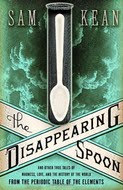
The Disappearing Spoon by Sam Kean
Though I didn’t keep strict track, I think Kean includes a tale for every single element in this terrific book. And while he did so, he opened my eyes to things I’d forgotten (or not ever known!!), for example:
• Chemistry is based on atoms’ electrons and physics on their nuclei;
• "Alchemy" is true: every element traces back to the fusion of solar hydrogen atoms into helium;
• The familiar Periodic Table is just one of many potential configurations of the elements, some of which are 3D;
• There are more than three states of matter;
• Our bodies don’t monitor whether we’re inhaling enough oxygen, only that we’re exhaling enough carbon dioxide;
• Midas was real as well as fictional;
• Why sci-fi life forms are based on silicon;
• Why Americans call it “aluminum” but it’s “aluminium” to everybody else.
There’s chemistry here, and physics and biology. But there’s also astronomy, geology, history, politics, warfare, economics, gender studies, human ambition and inter-personal conflict. And there’s a whole lotta humor. There are also dozens of entertaining and informative endnotes, suggestions for further reading, and an index. The only way to make it even better is to pair it with Theodore Gray’s The Elements.
Get started by taking a look at the disappearing spoon of the title.
Review based on an advance reading copy provided by the publisher

The Disappearing Spoon
by Sam KeanI ended up with an honors degree in physics, but [...] my real education was in my professors’ stories. [...] I realized that there’s a funny, or odd, or chilling tale attached to every element on the periodic table.Kean came to those professors already primed for their stories -- by having been fascinated to find mercury not only in the Periodic Table of science class but also in his childhood thermometers ... in literature’s mad hatter ... and in the mercury-laxative leftovers discovered in Lewis & Clark’s trail of latrines.
Though I didn’t keep strict track, I think Kean includes a tale for every single element in this terrific book. And while he did so, he opened my eyes to things I’d forgotten (or not ever known!!), for example:
• Chemistry is based on atoms’ electrons and physics on their nuclei;
• "Alchemy" is true: every element traces back to the fusion of solar hydrogen atoms into helium;
• The familiar Periodic Table is just one of many potential configurations of the elements, some of which are 3D;
• There are more than three states of matter;
• Our bodies don’t monitor whether we’re inhaling enough oxygen, only that we’re exhaling enough carbon dioxide;
• Midas was real as well as fictional;
• Why sci-fi life forms are based on silicon;
• Why Americans call it “aluminum” but it’s “aluminium” to everybody else.
There’s chemistry here, and physics and biology. But there’s also astronomy, geology, history, politics, warfare, economics, gender studies, human ambition and inter-personal conflict. And there’s a whole lotta humor. There are also dozens of entertaining and informative endnotes, suggestions for further reading, and an index. The only way to make it even better is to pair it with Theodore Gray’s The Elements
.Get started by taking a look at the disappearing spoon of the title.
Review based on an advance reading copy provided by the publisher
Monday, January 3, 2011
2010 Top 10: Pheromone
Third in a series of reviews of my 10 favorite books read in 2010, presented in alphabetical order.

Pheromone by Christopher Marley
Phenomenal er, I mean Pheromone, is a stunning photographic collection of Christopher Marley’s insect artwork.
I first heard of Marley on a CBS Sunday Morning segment. He grew into adulthood hating insects (their legs, especially), but when the colors, shapes and textures of particularly remote species caught his artist’s eye, his dread turned to fascination. His specimens are sustainably collected from around the world, supporting local tribes and their efforts to resist deforestation (and with it the loss of habitat that results in species endangerment).
He preserves, mounts and frames the insects, sometimes arranging mixed species (like the “mosaic” on the book’s cover, a sort of insect version of a wildflower garden), but more often composing groups of a single species (evocative of massed tulips) or even a striking lone insect. The nubby and hairy textures are practically tactile, the colors are fabulous, and every image is lively -- the circularity of a mandala of longhorn beetles; the waves of color washing across a page of massed scarabs; the page-full of 95%-identical moths that highlights their individuating differences. The book's Endnotes include the title of each work of art; the insect specimen’s common name, scientific name, geographic location and actual size; and sometimes Marley’s personal comments, which made me re-visit the images with new insight.
You can browse Marley’s gallery here, but I've given more than a passing thought to pulling out some of the book’s pages to frame.

Pheromone
by Christopher MarleyI first heard of Marley on a CBS Sunday Morning segment. He grew into adulthood hating insects (their legs, especially), but when the colors, shapes and textures of particularly remote species caught his artist’s eye, his dread turned to fascination. His specimens are sustainably collected from around the world, supporting local tribes and their efforts to resist deforestation (and with it the loss of habitat that results in species endangerment).
He preserves, mounts and frames the insects, sometimes arranging mixed species (like the “mosaic” on the book’s cover, a sort of insect version of a wildflower garden), but more often composing groups of a single species (evocative of massed tulips) or even a striking lone insect. The nubby and hairy textures are practically tactile, the colors are fabulous, and every image is lively -- the circularity of a mandala of longhorn beetles; the waves of color washing across a page of massed scarabs; the page-full of 95%-identical moths that highlights their individuating differences. The book's Endnotes include the title of each work of art; the insect specimen’s common name, scientific name, geographic location and actual size; and sometimes Marley’s personal comments, which made me re-visit the images with new insight.
You can browse Marley’s gallery here, but I've given more than a passing thought to pulling out some of the book’s pages to frame.
Sunday, January 2, 2011
2010 Top 10: Packing for Mars
Second in a series of reviews of my 10 favorite books read in 2010, presented in alphabetical order.

Packing for Mars by Mary Roach
It seems like a previous life: the mid-1980s and NASA’s program to send the first American “civilian” into space. I was interested, then sidelined when applications were restricted to teachers, then stunned by the Challenger launch disaster. But now I’m delighted to get a sort of ride-along with the clever and uber-curious Mary Roach in Packing for Mars.
She begins: “To the rocket scientist, you are a problem. You are the most irritating piece of machinery he or she will ever have to deal with.” And then she dives in to explore that human machinery in space and how everything -- procedures, equipment and supplies -- is designed to best serve it.
Through examples from animal simulations and crash-test cadavers, the race-for-space/ shuttle/ space-station projects, and potential Mars-length missions, she examines astronaut selection; the effects of isolation, inactivity and cramped spaces; the spectrum from weightlessness to multiple g-forces; eating, eliminating, and hygiene; and … well, enough with the listmaking; it hints at dull and anyone who’s read Roach knows she doesn’t do dull. Instead, she mines excellent and surprising information about physics and biology -- and what most captures me is her practicality, for example this from a passage about religious observations aboard the space station:
I loved Roach's Stiff, but Spook -- not as much, so skipped Bonk (until now, maybe). She's a front-and-center kind of narrator, a participant even, and Spook seemed too much about her. Here, she’s back in terrific Stiff form -- (wo)manning the audio and video for us like a TV news crew, giving just an occasional glimpse of her metaphoric microphone to remind us she's there. Though she isn’t a slave to structure and linearity, there’s a satisfying organization of her material into chapters here. And all of her interesting-but-off-topic segues? -- they’re here too, in a hundred witty footnotes. She also references dozens of space-travel articles, histories, biographies and memoirs, and lists them in a bibliography.

Packing for Mars
by Mary RoachIt seems like a previous life: the mid-1980s and NASA’s program to send the first American “civilian” into space. I was interested, then sidelined when applications were restricted to teachers, then stunned by the Challenger launch disaster. But now I’m delighted to get a sort of ride-along with the clever and uber-curious Mary Roach in Packing for Mars.
She begins: “To the rocket scientist, you are a problem. You are the most irritating piece of machinery he or she will ever have to deal with.” And then she dives in to explore that human machinery in space and how everything -- procedures, equipment and supplies -- is designed to best serve it.
Through examples from animal simulations and crash-test cadavers, the race-for-space/ shuttle/ space-station projects, and potential Mars-length missions, she examines astronaut selection; the effects of isolation, inactivity and cramped spaces; the spectrum from weightlessness to multiple g-forces; eating, eliminating, and hygiene; and … well, enough with the listmaking; it hints at dull and anyone who’s read Roach knows she doesn’t do dull. Instead, she mines excellent and surprising information about physics and biology -- and what most captures me is her practicality, for example this from a passage about religious observations aboard the space station:
Zero gravity and a ninety-minute orbital day created so many questions for Muslim astronauts that a [guideline] was drafted. Rather than require [them] to pray five times during each ninety-minute orbit of Earth, they were allowed to go by the twenty-four-hour cycle of the launch location.How to stay oriented toward Mecca at such speed and prostrate oneself in weightlessness are also addressed.
I loved Roach's Stiff, but Spook -- not as much, so skipped Bonk (until now, maybe). She's a front-and-center kind of narrator, a participant even, and Spook seemed too much about her. Here, she’s back in terrific Stiff form -- (wo)manning the audio and video for us like a TV news crew, giving just an occasional glimpse of her metaphoric microphone to remind us she's there. Though she isn’t a slave to structure and linearity, there’s a satisfying organization of her material into chapters here. And all of her interesting-but-off-topic segues? -- they’re here too, in a hundred witty footnotes. She also references dozens of space-travel articles, histories, biographies and memoirs, and lists them in a bibliography.
Saturday, January 1, 2011
2010 Top 10: American Terroir
First in a series of reviews of my 10 favorite books read in 2010, presented in alphabetical order.

American Terroir by Rowan Jacobsen
Jacobsen organizes years of research and tasting into a dozen essays, each a primer on a food and an armchair trip to a locale: Vermont maple syrup, (hard) cider and cheese; Washington apples and oysters; California wine; locavore honeys and mead wine; Alaskan salmon; Prince Edward Island mussels; Quebec mushrooms and forest greens; Mexican avocados and chocolate; Panamanian coffee.
There’s history, biology, climatology, gastronomy, agriculture, production and business, and as close to a tasting as a book can get ... all packaged in Jacobsen’s engaging narration, which has hints of Michael Pollan and Mary Roach. And each essay concludes with a recipe or two plus a list of sources that made me dizzy with possibility (first up: an orange-blossom sparkling mead wine).
*pronounced like Renoir
Review based on a copy of the book provided by the publisher

American Terroir
by Rowan Jacobsen[Terroir is] a partnership between person, plant and environment to bring something unique into the world. The soil and climate set the conditions; the plants, animals, and fungi respond to them; and then people determine how to bring out the goodness of those foods and drinks.American Terroir* is Jacobsen’s exploration of that “taste of place” -- why certain locales grow certain plants and animals so well, and the attentive harvesting and processing that transform them into outstanding foods. Think artisanal not industrial; imagine a reversal of the past century’s flight from the farm and from all things "earthy."
Jacobsen organizes years of research and tasting into a dozen essays, each a primer on a food and an armchair trip to a locale: Vermont maple syrup, (hard) cider and cheese; Washington apples and oysters; California wine; locavore honeys and mead wine; Alaskan salmon; Prince Edward Island mussels; Quebec mushrooms and forest greens; Mexican avocados and chocolate; Panamanian coffee.
There’s history, biology, climatology, gastronomy, agriculture, production and business, and as close to a tasting as a book can get ... all packaged in Jacobsen’s engaging narration, which has hints of Michael Pollan and Mary Roach. And each essay concludes with a recipe or two plus a list of sources that made me dizzy with possibility (first up: an orange-blossom sparkling mead wine).
*pronounced like Renoir
Review based on a copy of the book provided by the publisher
Thursday, December 30, 2010
2010 Reading Recap
This year had lots of good books, some great books, and some books I’m now an evangelist :) for. My full list follows, in reverse chronological order read, sorted by fiction/nonfiction and including ratings (out of 5 stars). Click the link to read my review. Click the book’s image (most are included at the end of this post) to peruse it on Amazon.
Scan the list and you’ll find very few books I didn’t like. As for favorites -- I’ll highlight my Top 10 by posting individual reviews, in alphabetical order of the title, over the first ten days of January.
Fiction
91. The Things They Carried by Tim O’Brien (4)
90. You Know When the Men Are Gone by Siobhan Fallon (4.5) (See review)
88. A Christmas Memory by Truman Capote (3.5) (See review)
87. An Object of Beauty by Steve Martin (3) (See review)
85. Great House by Nicole Krauss (3.5)
84. Touch by Adania Shibli (4.5) (See review)
73. The Last Days of Ptolemy Grey by Walter Mosley (4.5) (See review)
72. The Bluest Eye by Toni Morrison (4) (See review)
70. The Recipe Club by Andrea Israel/Nancy Garfinkel (2) (See review)
68. Saturday by Ian McEwan (3.5)
65. Ellen Foster by Kaye Gibbons (4)
63. A Visit From the Goon Squad by Jennifer Egan (4) (See review)
62. All Is Forgotten, Nothing Is Lost by Lan Samantha Chang (3.5) (See review)
59. Sum: Forty Tales From the Afterlives by David Eagleman (4) (See review)
51. The Breaking of Eggs by Jim Powell (4.5) (See review)
48. This Must Be the Place by Kate Racculia (2.5) (See review)
45. The House on Mango Street by Sandra Cisneros (3.5) (See review)
43. The Lion by Nelson DeMille (3.5) (See review)
42. Countdown by Deborah Wiles (4) (See review)
41. The Particular Sadness of Lemon Cake by Aimee Bender (4) (See review)
38. Girl in Translation by Jean Kwok (4) (See review)
37. Light Boxes by Shane Jones (3.5) (See review)
35. Mrs. Somebody Somebody by Tracy Winn (3) (See review)
33. Day for Night by Frederick Reiken (4.5) (See review)
32. Gents by Warwick Collins (3)
31. The Imperfectionists by Tom Rachman (4.5) (See review)
30. Beatrice and Virgil by Yann Martel (3) (See review)
29. The Irresistible Henry House by Lisa Grunwald (3) (See review)
28. We the Children by Andrew Clements (3) (See review)
25. Chess Story by Stefan Zweig (4)
24. Imperfect Birds by Anne Lamott (3) (See review)
22. The Waitress Was New by Dominique Fabre (4.5) (See review)
21. The Young Visiters by Daisy Ashford (3) (See review)
20. The Heights by Peter Hedges (3) (See review)
17. The Solitude of Prime Numbers by Paolo Giordano (4) (See review)
16. Refusing Heaven (poems) by Jack Gilbert (3)
13. The Incident Report by Martha Baillie (4) (See review)
11. Secrets of Eden by Chris Bohjalian (3.5) (See review)
9. The Wife's Tale by Lori Lansens (3.5) (See review)
6. A Beginning, a Muddle, and an End by Avi (2.5)
3. The Pursuit of Other Interests by Jim Kokoris (3.5) (See review)
Nonfiction
89. American Terroir by Rowan Jacobsen (4.5) (See review)
86. 365 Thank Yous by John Kralik (3) (See review)
83. Dreaming in Chinese by Deborah Fallows (3.5)
82. The Sound of a Wild Snail Eating by Elisabeth Tova Bailey (4) (See review)
81. Simple Times: Crafts for Poor People by Amy Sedaris (4) (See review)
80. Penguin 75 ed. by Paul Buckley (3)
79. The Gourmet Cookie Book (3)
78. Mad Men: The Illustrated World by Dyna Moe (3)
77. The Shallows by Nicholas Carr (4)
76. The Fashion File by Janie Bryant (3.5) (See review)
75. The Checklist Manifesto by Atul Gawande (4) (See review)
74. Pheromone by Christopher Marley (5) (See review)
71. The Book of "Unnecessary" Quotation Marks by Bethany Keeley (3) (See review)
69. Huck by Janet Elder (2) (See review)
67. Chip Kidd: Book One by Chip Kidd (4) (See review)
66. Turn and Jump by Howard Mansfield (3) (See review)
64. Brain Candy by Garth Sundem (3.5) (See review)
61. True Prep by Lisa Birnbach (3.5) (See review)
60. The Geometry of Pasta by Caz Hildebrand / Jacob Kenedy (4.5) (See review)
58. Passages in Caregiving by Gail Sheehy (3.5) (See review)
57. Over: The American Landscape at the Tipping Point by Alex MacLean (4)
56. Change by Design by Tim Brown (2.5) (See review)
55. The Playbook by Alex MacLean (4)
54. Packing for Mars by Mary Roach (4.5) (See review)
53. Extraordinary Clouds by Richard Hamblyn (4) (See review)
52. The Disappearing Spoon by Sam Kean (4.5) (See review)
50. A Cabinet of Roman Curiosities by J.C. McKeown (3.5) (See review)
49. Kick-Ass Creativity by Mary Beth Maziarz (3.5) (See review)
47. Just Like Someone Without Mental Illness Only More So by Mark Vonnegut (4.5) (See review)
46. Wrong: Why Experts Keep Failing Us by David Freedman (3) (See review)
44. Cutting Rhythms by Karen Pearlman (4.5) (See review)
40. Sh*t My Dad Says by Justin Halpern (4.5) (See review)
39. Maus II: A Survivor’s Tale: And Here My Troubles Began by Art Spiegelman (4.5)
36. Jenniemae and James by Brooke Newman (3) (See review)
34. Aspergirls by Rudy Simone (4) (See review)
27. The Language God Talks: On Science and Religion by Herman Wouk (3.5) (See review)
26. Forbes City Guide Chicago 2010 (reference) (4) (See review)
23. Martha Stewart's Encyclopedia of Sewing and Fabric Crafts (reference) (4) (See review)
19. The Art of Choosing by Sheena Iyengar (4) (See review)
18. Blankets by Craig Thompson (4)
15. Words Fail Me by Teresa Monachino (3)
14. It All Changed in an Instant: More Six-Word Memoirs (2.5) (See review)
12. Obsolete by Anna Jane Grossman (3.5) (See review)
10. Making Rounds With Oscar by David Dosa (3) (See review)
8. The Visual Display of Quantitative Information by Edward Tufte (5) (See review)
7. The Paris Review Interviews I (5) (See comments)
5. The Elements by Theodore Gray (5) (See review)
4. How to Teach Physics to Your Dog by Chad Orzel (3.5) (See review)
2. Maus I: A Survivor's Tale: My Father Bleeds History by Art Spiegelman (4)
1. The Happiness Project by Gretchen Rubin (3.5) (See review)
Scan the list and you’ll find very few books I didn’t like. As for favorites -- I’ll highlight my Top 10 by posting individual reviews, in alphabetical order of the title, over the first ten days of January.
Fiction
91. The Things They Carried by Tim O’Brien (4)
90. You Know When the Men Are Gone by Siobhan Fallon (4.5) (See review)
88. A Christmas Memory by Truman Capote (3.5) (See review)
87. An Object of Beauty by Steve Martin (3) (See review)
85. Great House by Nicole Krauss (3.5)
84. Touch by Adania Shibli (4.5) (See review)
73. The Last Days of Ptolemy Grey by Walter Mosley (4.5) (See review)
72. The Bluest Eye by Toni Morrison (4) (See review)
70. The Recipe Club by Andrea Israel/Nancy Garfinkel (2) (See review)
68. Saturday by Ian McEwan (3.5)
65. Ellen Foster by Kaye Gibbons (4)
63. A Visit From the Goon Squad by Jennifer Egan (4) (See review)
62. All Is Forgotten, Nothing Is Lost by Lan Samantha Chang (3.5) (See review)
59. Sum: Forty Tales From the Afterlives by David Eagleman (4) (See review)
51. The Breaking of Eggs by Jim Powell (4.5) (See review)
48. This Must Be the Place by Kate Racculia (2.5) (See review)
45. The House on Mango Street by Sandra Cisneros (3.5) (See review)
43. The Lion by Nelson DeMille (3.5) (See review)
42. Countdown by Deborah Wiles (4) (See review)
41. The Particular Sadness of Lemon Cake by Aimee Bender (4) (See review)
38. Girl in Translation by Jean Kwok (4) (See review)
37. Light Boxes by Shane Jones (3.5) (See review)
35. Mrs. Somebody Somebody by Tracy Winn (3) (See review)
33. Day for Night by Frederick Reiken (4.5) (See review)
32. Gents by Warwick Collins (3)
31. The Imperfectionists by Tom Rachman (4.5) (See review)
30. Beatrice and Virgil by Yann Martel (3) (See review)
29. The Irresistible Henry House by Lisa Grunwald (3) (See review)
28. We the Children by Andrew Clements (3) (See review)
25. Chess Story by Stefan Zweig (4)
24. Imperfect Birds by Anne Lamott (3) (See review)
22. The Waitress Was New by Dominique Fabre (4.5) (See review)
21. The Young Visiters by Daisy Ashford (3) (See review)
20. The Heights by Peter Hedges (3) (See review)
17. The Solitude of Prime Numbers by Paolo Giordano (4) (See review)
16. Refusing Heaven (poems) by Jack Gilbert (3)
13. The Incident Report by Martha Baillie (4) (See review)
11. Secrets of Eden by Chris Bohjalian (3.5) (See review)
9. The Wife's Tale by Lori Lansens (3.5) (See review)
6. A Beginning, a Muddle, and an End by Avi (2.5)
3. The Pursuit of Other Interests by Jim Kokoris (3.5) (See review)
Nonfiction
89. American Terroir by Rowan Jacobsen (4.5) (See review)
86. 365 Thank Yous by John Kralik (3) (See review)
83. Dreaming in Chinese by Deborah Fallows (3.5)
82. The Sound of a Wild Snail Eating by Elisabeth Tova Bailey (4) (See review)
81. Simple Times: Crafts for Poor People by Amy Sedaris (4) (See review)
80. Penguin 75 ed. by Paul Buckley (3)
79. The Gourmet Cookie Book (3)
78. Mad Men: The Illustrated World by Dyna Moe (3)
77. The Shallows by Nicholas Carr (4)
76. The Fashion File by Janie Bryant (3.5) (See review)
75. The Checklist Manifesto by Atul Gawande (4) (See review)
74. Pheromone by Christopher Marley (5) (See review)
71. The Book of "Unnecessary" Quotation Marks by Bethany Keeley (3) (See review)
69. Huck by Janet Elder (2) (See review)
67. Chip Kidd: Book One by Chip Kidd (4) (See review)
66. Turn and Jump by Howard Mansfield (3) (See review)
64. Brain Candy by Garth Sundem (3.5) (See review)
61. True Prep by Lisa Birnbach (3.5) (See review)
60. The Geometry of Pasta by Caz Hildebrand / Jacob Kenedy (4.5) (See review)
58. Passages in Caregiving by Gail Sheehy (3.5) (See review)
57. Over: The American Landscape at the Tipping Point by Alex MacLean (4)
56. Change by Design by Tim Brown (2.5) (See review)
55. The Playbook by Alex MacLean (4)
54. Packing for Mars by Mary Roach (4.5) (See review)
53. Extraordinary Clouds by Richard Hamblyn (4) (See review)
52. The Disappearing Spoon by Sam Kean (4.5) (See review)
50. A Cabinet of Roman Curiosities by J.C. McKeown (3.5) (See review)
49. Kick-Ass Creativity by Mary Beth Maziarz (3.5) (See review)
47. Just Like Someone Without Mental Illness Only More So by Mark Vonnegut (4.5) (See review)
46. Wrong: Why Experts Keep Failing Us by David Freedman (3) (See review)
44. Cutting Rhythms by Karen Pearlman (4.5) (See review)
40. Sh*t My Dad Says by Justin Halpern (4.5) (See review)
39. Maus II: A Survivor’s Tale: And Here My Troubles Began by Art Spiegelman (4.5)
36. Jenniemae and James by Brooke Newman (3) (See review)
34. Aspergirls by Rudy Simone (4) (See review)
27. The Language God Talks: On Science and Religion by Herman Wouk (3.5) (See review)
26. Forbes City Guide Chicago 2010 (reference) (4) (See review)
23. Martha Stewart's Encyclopedia of Sewing and Fabric Crafts (reference) (4) (See review)
19. The Art of Choosing by Sheena Iyengar (4) (See review)
18. Blankets by Craig Thompson (4)
15. Words Fail Me by Teresa Monachino (3)
14. It All Changed in an Instant: More Six-Word Memoirs (2.5) (See review)
12. Obsolete by Anna Jane Grossman (3.5) (See review)
10. Making Rounds With Oscar by David Dosa (3) (See review)
8. The Visual Display of Quantitative Information by Edward Tufte (5) (See review)
7. The Paris Review Interviews I (5) (See comments)
5. The Elements by Theodore Gray (5) (See review)
4. How to Teach Physics to Your Dog by Chad Orzel (3.5) (See review)
2. Maus I: A Survivor's Tale: My Father Bleeds History by Art Spiegelman (4)
1. The Happiness Project by Gretchen Rubin (3.5) (See review)
Friday, December 3, 2010
What Does It Take...
...to coax out a muse?
This:
Of course this was pre-arranged ... in the mall.
(But what’s happening ... in you, now?)
This:
Of course this was pre-arranged ... in the mall.
(But what’s happening ... in you, now?)
Tuesday, August 31, 2010
What You Want to Know
From a recent segment of The Leonard Lopate Show, it’s clear that novelist Ayelet Waldman is less a proponent of “write what you know” and more of “write what you can imagine” -- that is, "what you want to know."
Because writing is an avenue to discovery, she pursues all sorts of real-life “want to knows” through her fiction. Her latest novel, Red Hook Road, was prompted by a terrible car accident that she recalls reading about in a newspaper. Also interested in classical music, she learned about it and weaved it in. And boxing. And boats.
For her next book, Waldman went totally “want to know.” She Googled keywords of topics that interested her: Hungary (she wanted to visit a friend there and liked the excuse of researching a writing project) + Holocaust (she’s Jewish and hadn’t written about it) + art (as with the music of Red Hook Road, she was interested) = a novel about the Hungarian Gold Train at the end of WWII.
I can’t wait to read it.
Because writing is an avenue to discovery, she pursues all sorts of real-life “want to knows” through her fiction. Her latest novel, Red Hook Road, was prompted by a terrible car accident that she recalls reading about in a newspaper. Also interested in classical music, she learned about it and weaved it in. And boxing. And boats.
For her next book, Waldman went totally “want to know.” She Googled keywords of topics that interested her: Hungary (she wanted to visit a friend there and liked the excuse of researching a writing project) + Holocaust (she’s Jewish and hadn’t written about it) + art (as with the music of Red Hook Road, she was interested) = a novel about the Hungarian Gold Train at the end of WWII.
I can’t wait to read it.
Wednesday, August 25, 2010
What Are the Odds?!
Stay with this video for the first minute-and-a-half, then just laugh for the next minute:
Thursday, August 12, 2010
Oh Yeah, Someone Cares
The cliché years ago, when weblogs were just becoming mainstream, was that most were mind-numbingly dull diaries along the lines of “what I had for lunch.” The hard truth was: No One Cares!
Turns out that’s not true.
While reviewing a company’s business policy on travel-expense reimbursement, I was surprised to see it doesn’t allow a general per-diem nor accept the IRS threshold that only expenses above a certain level (currently $75) require documentary receipts. Rather, every dollar needs support. And when it’s meals, forget submitting the summary/signature receipt -- this company requires the server’s item-by-item listing of your lunch.
Now let your imagination loose and consider some of their other policies. Heh. You’re not even close.
Turns out that’s not true.
While reviewing a company’s business policy on travel-expense reimbursement, I was surprised to see it doesn’t allow a general per-diem nor accept the IRS threshold that only expenses above a certain level (currently $75) require documentary receipts. Rather, every dollar needs support. And when it’s meals, forget submitting the summary/signature receipt -- this company requires the server’s item-by-item listing of your lunch.
Now let your imagination loose and consider some of their other policies. Heh. You’re not even close.
Thursday, July 29, 2010
Begin with a Character
I sooo believe everybody has a story -- that lives seemingly ordinary on the surface turn interesting deeper in. Consider these juror/alternate juror bios* -- some are immediately novel-worthy; others have real potential; still others seem such impossibilities that I’m frankly intrigued by the challenge:
103, a quiet-spoken white woman in her 20s who works as a full-time legal assistant
105, an African-American woman who teaches math to sixth- and seventh-graders in public school; her husband is a state probation officer
106, a white, female retired director for state public health department who has served on two juries before
115, a blond woman in her 30s or 40s who has worked in retail for the past 15 years; a fan of boating and gardening, she reads news "only for the weather"
119, a mother in her late 20s or early 30s who works in investment accounting and is an avid runner
121, a white, female accounting student at Western Illinois University with an interest in law; her father is a police officer
123, a white, male human resources manager in his 30s who volunteers for a family shelter and has done volunteer work for political candidates
127, a woman in 50s or 60s who likes reading and crafts like knitting and cross-stitch
128, a white community college student and former Best Buy salesman who likes sports, videogames and hanging out with his friends
133, a former Marine of 18 years who served in various places, including Beirut, where he suffered an injury; he has had a hip replacement and was concerned about sitting for long periods of time
135, a retired man in his mid-60s who said he was born in a Japanese internment camp in California; a former Marine, he has served on a jury
137, a retired Navyman who works full-time
148, an African-American, church-going man who worked as a letter carrier for 30 years; has served on two juries in the past, one of which did not reach a verdict
151, a mechanical engineer with a graduate degree who supervises a crew of 30 at a steel company
153, a female secretary and paralegal in the real estate department of a law firm
155, a secretary at Northwestern Memorial Hospital who volunteers at her church and used to be an event planner for a dating service; said it was hard to avoid the news, but believed she could be fair
156, young women who works in direct mail marketing and likes spending time with her boyfriend and her dog
166, a female, African-American social worker for a nursing home with a college degree
* From the Chicago Sun-Times coverage of the corruption trial of former Illinois governor Rod Blagojevich
103, a quiet-spoken white woman in her 20s who works as a full-time legal assistant
105, an African-American woman who teaches math to sixth- and seventh-graders in public school; her husband is a state probation officer
106, a white, female retired director for state public health department who has served on two juries before
115, a blond woman in her 30s or 40s who has worked in retail for the past 15 years; a fan of boating and gardening, she reads news "only for the weather"
119, a mother in her late 20s or early 30s who works in investment accounting and is an avid runner
121, a white, female accounting student at Western Illinois University with an interest in law; her father is a police officer
123, a white, male human resources manager in his 30s who volunteers for a family shelter and has done volunteer work for political candidates
127, a woman in 50s or 60s who likes reading and crafts like knitting and cross-stitch
128, a white community college student and former Best Buy salesman who likes sports, videogames and hanging out with his friends
133, a former Marine of 18 years who served in various places, including Beirut, where he suffered an injury; he has had a hip replacement and was concerned about sitting for long periods of time
135, a retired man in his mid-60s who said he was born in a Japanese internment camp in California; a former Marine, he has served on a jury
137, a retired Navyman who works full-time
148, an African-American, church-going man who worked as a letter carrier for 30 years; has served on two juries in the past, one of which did not reach a verdict
151, a mechanical engineer with a graduate degree who supervises a crew of 30 at a steel company
153, a female secretary and paralegal in the real estate department of a law firm
155, a secretary at Northwestern Memorial Hospital who volunteers at her church and used to be an event planner for a dating service; said it was hard to avoid the news, but believed she could be fair
156, young women who works in direct mail marketing and likes spending time with her boyfriend and her dog
166, a female, African-American social worker for a nursing home with a college degree
* From the Chicago Sun-Times coverage of the corruption trial of former Illinois governor Rod Blagojevich
Saturday, July 24, 2010
Fun with a Purpose
I was drawn to the Tom and Lorenzo/Project Rungay blog for its infotaining posts about Lost and Mad Men*. And now there's another layer to my visits: the blog’s Mad Style category of posts -- deep dissections of fashion as characterization -- are a virtual writing workshop!
* Season 4 premieres Sunday, July 25
* Season 4 premieres Sunday, July 25
Sunday, July 4, 2010

Monday, June 28, 2010
"The Arts Are Not Extracurricular"
On the importance of making art, from Just Like Someone Without Mental Illness Only More So *, a memoir
 by Mark Vonnegut -- Harvard-educated practicing pediatrician, son of Kurt, and four-episode psychotic:
*, a memoir 
The arts are not extracurricular.
[...]
Art is lunging forward without certainty about where you are going or how to get there, being open to and dependent on what luck, the paint, the typo, the dissonance, give you. Without art you’re stuck with yourself as you are and life as you think life is.
* To be released October 5
Subscribe to:
Posts (Atom)


 Posts
Posts


